Saturday, September 6, 2008

REVIEW: The Matrix Revolutions

That guy in the upper right almost makes Morpheus look svelte.


So here we go, the last Matrix movie, at least one would hope. The end of the trilogy. The sum of everything that the filmmakers were always intending from the series' humble beginnings, or at least so the Wachowski brothers claim. The final battle between Neo (Keanu Reeves) and the evil robot overlords that run the Matrix. And between Neo and the dastardly, out-of-control, frighteningly self-aware Agent Smith (Hugo Weaving, still the only one having a lick of fun), who's spamming himself through the Matrix like a Buy.com price alert. Trinity (Carrie-Ann Moss) fighting on behalf of the dreary man-god she loves, as she reminds us every 5 minutes. Morpheus (Laurence Fishburne) fighting his addiction to Meat-Normous breakfast sandwiches from Burger King. Anthony Zerbe (Anthony Zerbe) fighting to keep his scene from being cut. If none of this makes sense, first see the original The Matrix, and then see The Matrix Reloaded and/or my review of it. And if it still doesn't make sense, create a new forum topic on IMDB.com, and I'm sure all the Matrix fans will give you respectful and comprehensible answers.

"I am sorry, Keanu, but Bollywood's standards for acting quality are somewhat more exclusive."


After some idle exposition in the real world that recaps the end of the first movie, we see that Neo, comatose and in a sick bay at the end of the first movie, is somehow still plugged into the Matrix and his consciousness is in an underground subway station. There's some cute little Indian girl standing above him, and... Oh, god. It's starting again. The exposition. I... just can't take it... First, the girl, explaining to Neo why he's trapped in a subway station outside the Matrix. Then the Oracle (Mary Alice all of a sudden) explaining to Morph and Trin that Neo's in trouble. Then the girl's father, saying to Neo that they're a family of programs that are smuggling their daughter into the Matrix for a reason that the movie's willing to spend much more time explaining than I am. Jiminy Cricket, make it STOP! How many consecutive scenes do we need of people providing emotionless exposition while doing nothing else?

People for the Ethical Treatment of Pillars continues to boycott this series.


To get Neo out of purgatory in the train station, the Oracle sends her bodyguard, Seraph (Collin Chou) to help Morpheus and Trinity capture the Trainman (Bruce Spence, AKA the gyrocopter pilot from The Road Warrior, so I will not tolerate any criticism of this fine human being), who's the Merovingian's (Lambert Wilson) man in charge of smuggling things in and out of the Matrix, for whatever purpose that could possibly have. The trio of good guys chase the Trainman briefly, losing him because Morpheus now threatens a cardiac arrest with more than 15 seconds of sprinting. After we head back to the train station for more philosophical exposition from the Indian guy (Kill me now.), Seraph, Trinity, and Morpheus attack the Merovingian's hideout, Club Hel, which Wikipedia claims is the correct spelling. They first have to blast their way, without even the slightest effort at tactical positioning, through a room full of bad guys who walk on the ceiling. Why walk on the ceiling? I'm not sure what kind of an edge that gives them in a room that's about 8 feet high, but if it looks kind of weird and costs some money to pull off, it's good enough for the Wachowski brothers. Surprisingly enough, none of our heroes gets scratched or express the slightest hint of concern before dispatching the baddies. Then, instead of maybe using stealth or something, they preemptively engage in a Mexican standoff against a bunch of unarmed S&M types in the club (See? I told you they could have snuck in.). All that fighting so they could immediately surrender their guns and chat with the Merovingian, and what do you know? He doesn't want to give up Neo. You don't say. But since this is The Matrix, there's no bit of idiotic planning that can't be overcome by kicking something. After the Merovingian blathers some more about causality--Seriously, dude, is there anything else that interests you?--the good guys kick the iceberg-reflexed thugs holding them at gunpoint, put a gun to the Merovingian's head at the outset of ANOTHER Mexican stand-off, and demand that he give them Neo back. And so he does, and Neo and Trinity have a tearful reunion after being separated a whole half-hour.

That's not so much a dress as it is a cleavage levee.


Eighty minutes later, when Neo finishes talking to the Oracle about nothing we didn't already know, he trods off and Smith finally arrives to see her himself. So if he knows where she is, doesn't that mean all the bad guys know where she is? So why has it taken so long for someone to come kick granny's ass? Hugo Weaving does his damndest to be terrifying while musing (in what almost sounds like iambic pentameter) about the purposefulness of the Oracle's decision to not fight back, as if he's the bastard child of Nietzsche, Iago, and Sam I Am. After a mercifully brief chat, he turns her into a Smith, one that starts laughing maniacally. And boy, do I mean maniacally. In fact, Agent Smith's pure joy for being evil probably makes him the most sympathetic character in the movie. Neo? Trinity? Morpheus? I've heard more enthusiasm in cold reads of The Canterbury Tales in high school English. So the real choice of the movie is whether you want to turn into a Smith and have constant fun, or to go to Zion and end up as one of the three things: a stick in the mud, a brain-dead raver, or Anthony Zerbe. I know what I choossssse.
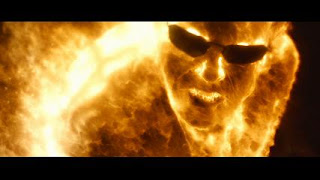
Agent Smith protests the Vietnam War.


Back in the real world, the Smith-infected Bane (Ian Bliss) has woken up, and after a brief interrogation--which should have begun with the question, "If your name's Bane, how could you NOT be evil?"--the other characters lose interest in him. And the directors lose interest in them, because it's back to Zion for a little while so that we can hear some people gripe about how outnumbered they are by the impending invaders. Then hear some minor characters griping about how they don't want to die. Then hear The Kid (Clayton Watson) gripe to Captain Mifune (Nathaniel Lees) about how he just wants to help out and fight the Krauts, er, Machines. Then we get to hear the dumb white guy captain of the one Zion ship gripe to Niobe (Jada Pinkett-Smith) about how they can't reach Zion in time to help in the fight, and then hear Niobe counter-gripe about how she's so damned awesome that she can fly his ship through an impossible-to-navigate tunnel that'll take them straight to Zion. Remember, being a female action heroine means never having to show the slightest humility. Meanwhile, Neo realizes that his only way to stop the war is to go to Evil Machine Capital for some reason.

And now, we see the sperm enter Gloria Steinem's uterus...


So they give him a ship and let him and Trinity head off, but unbeknownst to them, Smith-Man has stowed aboard. When Smith-Man makes his move, locking Trinity below decks (instead of taking the extra .5 seconds to kill her and toss her away) and holding Neo at gunpoint, he starts going on about how it was inevitable that he would break out of the Matrix and control the whole worrrrrrlllld! Ten minutes later, Neo figures out that this guy is Agent Smith. Definitely, this is a concept at odds with all past Matrix history that we know of, but considering that Neo is supposed to be the great and wise savior of the human race, you might have thought that he'd be quicker to at least get into the right frame of mind regarding the guy who does a perfect Agent Smith impression, calls him "Missster Anderson," and goes on rambling speeches about fate. Naturally, being held at gunpoint only means we're biding time until they start fighting over the gun, but despite losing the gun, Man-Smith does seemingly get the edge when he blinds Neo with a severed electrical cord. Too bad for him that in his blindness, Neo discovers that he actually has some weird screensaver-type vision that lets him see robots--which apparently includes computerized poltergeists that possess people's body, since Smith-Man not only has Agent Smith inhabiting his mind, but a full-blown scowling Agent Smith running the length of his body! Which makes it a lot easier for Neo to smack the guy's head off, thus allowing the audience to ditch ole Neo and Trin for a while, and enjoy the great characters of The Kid, Zee, Niobe, Ghost, and Fat Morpheus for the next hour.

"Too... much... botox...Uggghhh."


Next up on the Star Wars prequel-like tour of diverse and barely-related simultaneous fight scenes is the underground city of Zion, where the evil robot army has arrived and threatens Anthony Zerbe as we know it unless the valiant Zion soldiers can stop them. The defenders strap into Starship Troopers (the book)-like robot armor suits with machine guns on their hands (held sideways, because it's much more effective to hold dual-wielded pistols sideways), so that they can mow down the squid-robots that pour out of a hole at the top of their underground dock's huge dome. If that's a confusing description, just imagine what would happen if Quentin Tarantino adapted Galaga for the big screen, and that's more or less it. Un-armored infantry guys on the ground actually use ray guns to shoot the killer robo-squids. Do you think the Wachowskis regret introducing the ray guns in the first movie? They seem to clearly prefer machine guns in this movie, which strikes me as a step down technologically, especially when the giant mechs need little guys to run around and slap new cartridges into their machines every few minutes (which happens to be The Kid's job). You'd think having a few explosives would be useful against swarms of clustered enemies. The scene's kind of entertaining at the basest possible level a modern action movie can exist at, somewhere just below Stealth and just above Jackass. It's a level where characters can roar, "Where the hell's my infantry?!? I want that god-damned machine taken down!" and yet, paradoxically, the filmmakers expect all of this to be treated as profound by the audience. At least the robots don't stop to lecture on causality before attacking, a fact that immediately promotes them to the most sympathetic characters in the movie.

"Neo, you're completely blind. Quit criticizing my driving."


Meanwhile, Zion also dispatches lesbian prison babe bazooka teams to blow up the huge drilling robots, but when the robots' clunky extermination strategy meets the humans' clunky defense strategy, the edge still goes to the robots. Things start to look really bad in Zion, despite the fact that the vast majority of evil robots just fly around in formation, bunched up so that Zion's bullets can hit them that much more easily, and take only occasional interest in attacking something. But then somebody remembers that they can use the electro-magnetic pulse bombs (which were all the rage in the first movie) to instantly annihilate the entire invasion force, albeit at the cost of also destroying most of Zion's own defense weaponry. Given how things are going--"We can't hold them! Somebody needs to send in an 'S' power-up! We can't hold them back if we don't get the spreadshot! Or a bonus life! Anything!"--calling it even and shutting down all the evil robots seems like a decent idea. One problem: nobody thought ahead to keep one of those bombs at Zion. So the only ship in the quadrant--I'm sorry, Star Trek flashback--that has an EMP bomb is the idiot white guy captain's, which Niobe is piloting.


She's taking that shortcut of her's back to Zion, but accidentally alerts the evil robots, so she's got to go through the tunnels at maximum speed while the forty other minor characters on-board man the gun turrets. Which I'm sure pads out the tie-in video game very well, but this is not exactly the most engaging cinema. Niobe's piloting isn't very exciting either: the idiot white guy captain keeps exclaiming to no one in particular how impressed he is with her piloting, but given that we have no idea how maneuverable a sewer-traversing battleship in the year 3,000 is supposed to be, I'm not really sure how good at this she actually is. All I know is that I'm seeing a computer-generated electric razor streaking through a computer-generated tunnel while spraying bullets at computer-generated Contra enemies. Compound this boredom with the fact that Morpheus, once the true hero of the series, is reduced to riding shotgun and announcing useless information that even Lieutenant Chekhov would be embarrassed to mention, and being berated by Niobe the whole time for failing to shout out his numbers fast enough.

"Whoa. I don't like these new Swedish ergonomic chairs."


The ship's about to reach Zion, but the evil robots have already shut the gate, and the humans need a mechwarrior guy to shoot some chain to open it (Dude, I'm just explaining it; I didn't write it). Captain Mifune tries to make it to the gate, but is cut down by a swarm of squid-bots along the way, probably regretting not having any protective glass or shield installed on top of the pilots' compartments on the damn mechs. But the Kid's there to save the day, finally ready to fulfill his destiny of being the spunky little kid that could, the cyberpunk Rudy that wants to play the world's biggest Gradius game instead of Notre Dame football. So he hauls Mifune's mangled ass out of the giant mech, shoots the chain, and allows Niobe's ship to crash into Zion and kill all the evil robots with an EMP. Thus concluding the sequence with the greatest dollars-to-brain cells expenditure ratio in film history.

"Oh, god. We all wore the same thing. How embarrassing!"


Neo and Trinity fly their ship above ground and make their way to the evil robots' capital city, using Neo's magical robot-destroying telekinesis power (still not remotely explained, although at least acknowledged that it's inexplicable) to take out defenses along the way. Things still get hairy enough that they need to crash full-speed into one of the robot buildings, and Trinity gets impaled by shrapnel. Now, at this point, most movies would give her a few last blood-choked words with which to say goodbye. But this is The Matrix, where actors are paid by the word, so she says goodbye with a monologue to rival anything the stuffy old sentinent programs in the Matrix have to offer, and delivered at such a slow pace that I had to check to see if my DVD player was out of RAM or something. She doesn't sound so much like she's dying as that she's strapped into a dentist's office chair and being pumped full of some very cheap anesthesia while reciting her audition scene. Thus, Carrie-Ann Moss/Trinity leaves the series the same way she entered it: emotionless, unattractively made-up, and appallingly dull when she's not launching herself across the screen in slow-motion.

This just in from Wall Street: apparently, the housing bubble has burst.


Fortunately, just as the machines are on the brink of exterminating the Zionites once and for all, Neo cuts a deal with them: he'll re-enter the Matrix, which Smith has completely taken over, and kick his ass one last time to keep him from wiping out all the robots and humans together. In exchange, the robots have to leave Zion alone and let people leave the Matrix if they want to. Personally, considering that the Planet Earth looks like the South side of Mordor right now, I'd have just demanded that they redesign the Matrix to look more like Acapulco and let everyone back in.

Stop punching yourself! Stop punching yourself! Stop punching yourself!


The machines jack Neo back into the Matrix, beginning the climactic battle and arguably the best scene since the first Matrix. It's a real shame that such a cool scene has to follow two hours of idiots spinning around on the ceiling and machine guns spraying bullets at robotic lice. Neo arrives in the Matrix strolling down in the pouring rain in the dead of night, illuminated only by constant lightning. The sidewalks and buildings are lined with millions of Smiths now that he has copied himself onto every last person in the Matrix. An impressive choral score booms; music is perhaps the only great improvement the series has made since the first film, having mostly abandoned punk and heavy metal. A single Smith, presumably the one possessing the Oracle, steps out to declare that only he will fight Neo: he's foreseen his victory over Neo, so one fighter is enough. Unfortunately for Neo, Smith's gotten a lot stronger since the hundred-Smiths fight in the previous movie, where each Smith on its own could have gotten taken down by a half-drunk Anthony Zerbe. This time around, Smith can fly and smash into Neo so hard that shockwaves expand like giant bubbles in the rain. Like most Matrix fights, the whole thing outlasts its welcome a bit, but has enough striking images and glorious Smith-ness ("Missster Andersssson, welcome back. We missssed you. Like what I've done with the place?" Truly a great line in a movie filled with awful dialogue.) that I was genuinely excited.

Oh, so THAT's why they all wear sunglasses.


Furthermore, it has a somewhat interesting ending. After a long fight, Neo ultimately allows Smith to absorb him and seemingly claim victory. However, because the machines themselves are plugging Neo into the Matrix themselves, they shoot some kind of a computer virus into him, and it spreads to Smith, blasting him out of existence and freeing all the people in the Matrix that Smith has absorbed. Granted, considering that the evil robots also control nearly every other person inside the Matrix in the same way, I'm not sure what they needed Neo for. But I'll trust that it's entirely possible there's some explanation the writers didn't want to create a long, rambling monologue to spell out, so I'll shut my fat yap and let it be.

We get to hear The Kid announce to an elated Zion that the war is over, making us wish it had lasted just long enough to do him in, and we get to see the Oracle have one last dialogue (not monologue; imagine that!) with the Architect, who is long on wind, but short on screen time, thank God, and we're done. Done! And the closing credits music is kind of cool too, in an odd, uncomfortable way. At least the last 15 or so minutes of The Matrix Revolutions depart from the original vision in that they're not acting like one of the most awful big-budget modern movies I've ever seen.

"Oh, no. You can't sign me for another sequel just when The Hobbit is scheduled to film. It's just not fair!"


I must admit that in retrospect, the plots for The Matrix Reloaded and The Matrix Revolutions do sound good when you read an in-depth examination of them by an interested writer (such as on Wikipedia, your one-stop shop for obsessive over-analysis on the web). It's definitely not a conventional storyline, and while not necessarily insightful into the human condition--that's what a mishmash of academia will do to you--it's an interesting exercise in its own right. The problem is that there's an actual movie we need to watch, and while the philosophy and allusion would be great fun as a backdrop to a plot-focused film, the Wachowskis let it slow down one that's already padded out and poorly acted. It's a movie that's supposed to be about how and why humans keep on going, yet can't muster anything except the most shallow relationships and motivations for its actual human characters.

And that's not even mentioning the horrendous Battle of Zion sequence that's long and dumb enough to kill off all those brain cells you were devoting to the question of what the point of the Indian guy at the beginning was. Seriously, when you go from an hour of Matrix pseudo-philosophy to an hour of Smash TV, the effect is like getting smashed on the head by a hammer to offset the feeling of getting smacked in the nuts by a carpet beater. I get the feeling that the directors were largely out of ideas, on both the high-minded sci-fi and over-the-top action fronts, and tried to compensate by overdoing the hell out of both aspects of the series. I'm not entirely sure that the Wachowski's apparent struggle to make these movies work indicates any great humility, though: after all, it takes quite a mind, or pair thereof, to make a Speed Racer movie seem smug.

"Oracle, look! Our prayers have been answered!" "What is it, dear? Has Neo returned?" "No, Oracle! The movie's over!"


So here's to Agent Smith, the scowling ass of a villain, whose hatred of Keanu Reeves and tireless efforts to keep the Matrix movies focused on, y'know, the Matrix proved to be an inspiration to us all. Perhaps he'll return one day. Maybe next time your story will be told by filmmakers who know there's more to life than Nietzsche, LSD, and R-Type.

Wednesday, September 3, 2008

COMING SOON: The Matrix Revolutions

There's only one hope for redeeming this franchise: Anthony Zerbe in a black trenchcoat and sunglasses. Will it happen? Stay tuned...

Saturday, August 23, 2008

REVIEW: The Matrix Reloaded

A shot of people in black trenchcoats standing around looking bored. Yes, this is a surprisingly honest piece of cover art.


I see the follow-ups to 1999's The Matrix and 2003's Pirates of the Caribbean as having the same basic approach and the same basic problems. Both of the original movies had memorable characters and clever premises, and were basically good blockbuster action movies that were breaths of fresh air compared to all the generic sequels and remakes cluttering the big screens. They were good summer thrill rides, both in the action and the peripheral stories, in genres that most audiences hadn't recently seen.

9.2, 9.3, 8.9... Annnnnd, the Iranian judge gives her a 9.7.


When sequel time came for both films, the studios and filmmakers took the same approach: bring back the original director (or directors, the Wachowski brothers, in The Matrix's case) to make a pair of sequels filmed back-to-back so that we could have #2 and #3 released within a short time of each other, with the same actors guaranteed to return. And since these were both no longer daring gambles, but rather pop culture phenomena, let's make sure all the sequels are mega-budget, extremely long epics that take the small casts and nicely contained storylines of the originals and nuke them with complex subplots and tons of peripheral characters. And at the same time, let's lie to the press and pretend that these were intended to be trilogies all along, even though the first movies ended with satisfying and conclusive finishes.


The Secret Service under Barack Obama.


And both sets of sequels had the same results: #2 made the most money of the respective series, due to huge advertising budgets and the massive exposure of the original films, but left audiences confused and bored. They realized that the original films were the Skittles of moviedom: the first handful is pretty darn sweet, but you realize that they're a lot less appealing when you have to get through a whole bag of them. So #3 in each series ended up taking far less than its predecessor, in stark contrast to the excellent Lord of the Rings series that made more and more money with each subsequent installment, or even the Star Wars prequels, which at least ended on a comparatively high note.


The Secret Service under John McCain.


As for The Matrix, the sequels had some other things going against it. Less than a month after the original's release, the Columbine massacre shocked Americans, and quite a few commentators noted that the black trenchcoat-clad, dispassionate, gun enthusiast heroes might have been an influence. I don't think the filmmakers are to blame for real acts of murder, but if the film wants credit for its allusions to religion and philosophy, it needs to also accept its allusions that glorify terrorism. Furthermore, in the aftermath of 9/11 and the invasions of Afghanistan and Iraq (the latter having started just two months before TMR's release), Neo and Morpheus and Trinity's religious zealousness to attack government buildings and bring down the system might have been a bit difficult to ignore anymore.


iMatrix


But enough prologue and pontification. I won't go into detail about the original Matrix's premise, since it's so damn complicated and everyone's seen it (and it's actually pretty good despite the fact that it's a bit anarchist and pretentious, so I won't review it on this site; it was briefly my favorite movie when I didn't know any better). Suffice to say that the evil machines of the future are still holding humans prisoner in a giant virtual reality world so they can power themselves with human body heat. The physics of this power source is highly unlikely -- if the Chinese government hasn't yet found a way to power their cars off of Tibetan orphans, I don't think it's going to happen. Oh, and even the most extreme environmentalist would agree that there's no problem with nuclear energy if there's no environment to worry about anymore. Regardless, rogue humans who have escaped their virtual prisons are still based in the secret underground city of Zion, still hack into the system, gain super reflexes and agility by disbelieving in the Matrix (which shouldn't be hard considering that the whole thing is frikkin' GREEN), download all sorts of learning progams directly to their brains (and get offers to download penis-enlarging programs all the damn time), and do something (I'm not entirely sure what) to mess with the machines and bring about a mass revolt. They still think that wearing gangster/dominatrix clothing and sunglasses helps them look inconspicuous.

"And I can assure you that I run a perfectly respectable castle and that it's someone else who's robbing your graves."


The new movie's prologue has Neo, AKA The One, dreaming about Trinity tearing up a security checkpoint in her usual destructive style. We then cut to her jumping out of the 200th floor of a skyscraper, trading bullets with an Agent as he falls after her. So what exactly happens if she kills him? Does knowing kung fu allow you to survive a 40,000 foot fall to Earth? Fortunately, it's just a dream/premonition, so we don't have to deal with the logic just yet.


As the real movie starts, the captains of the free (i.e. real) underground city of Zion's many sewer-traversing ships meet in the Matrix to discuss new intelligence revealing that the machines have figured out where Zion is, and they're sending a massive army of killer bots to wipe all the rebels out in 72 hours. Our hero, Neo (Keanu Reeves), is a bit concerned by this: while he's still so awesome in disbelieving in the Matrix that he can fly, wave away bullets, and use martial arts really well, his other skills have diminished so badly that he can't fight the evil AI Agents with one hand behind his back anymore, nor can he absorb and explode them from within like in the last movie. Gee, Wachowski brothers, do you think this might have been the problem with stretching the original film's very self-contained and complete story, which ended with Neo's realization of cyber-geek godhood, into two more movies? I was hoping to see the man do something else with his hacking powers, but he really just rehashes his abilities from the first movie, except for the really transcendent ones. It's like how in an RPG video game series, your character finishes the first game at level 60, tearing through giants like swiss cheese, then starts the sequel back at level 1, beating on dung beetles with wooden sticks.


"...And did I ever tell you about working with Robert Davi? Oh, surely you'd like to hear some more. Well, I had always been a great admirer of his work, and there's an interesting story there as well, because..."


War's coming! Only Neo, his guru Morpheus (Lawrence Fishburne, getting fatter with each take and getting fewer fight scenes with each movie), his gal pal Trinity (Carrie-Ann Moss), his own personal Chloe O'Brien, Link (Harold Perrineau, having demonstrated on Oz the ability to sit down for just about the whole show), and the rest of the crew of the Nebuchadnezzar can... Wait, this is too long a sentence. Let me start again. Only they can contact the mysterious, sympathetic artificial intelligence known as The Oracle (Gloria Foster, given the inglorious task of padding out a 138-minute movie) and find out what they have to do in order to bring the Matrix down before the machine army hits Zion. Awfully convenient that the Oracle decides only now to tell them what they have to do to finish the thing that their whole organization is dedicated to.

So they spring into action! By... heading back to Zion and... relaxing for a while. Yeah, I guess the 72-hour deadline isn't something to get too worried about. So we're introduced to the city that we'd only heard about in the first movie, and it's kind of a giant multi-story Arabian/Asimovian marketplace wrapped around a bunch of enormous boilers. Huh? This is vastly preferable to the Matrix? Whatever. The movie decides that since we've already had two brief action scenes at the start of the movie, we can take another half-hour break to get to know a bunch of other characters we won't care about now, but will somehow care about even less when they finally do something in the next movie. We have Zee (Nona Gaye), Link's wife, who may or may not have a full name of Zelda and get captured by the wizard Gannondorf in the fourth movie; Cas (Gina Torres), whom I can't remember a thing about; Niobe (Jada Pinkett-Smith), who fills the role of deadpan ultra-confident warrior woman, which apparently hasn't been filled sufficiently; Lock (Harry Lennix), the stick-in-the-mud, Neo-doubting commander of the Zion defense forces; Councilor West (Cornell West, a radical socialist activist who's apparently furthering his cause by appearing in a radical libertarian movie); the Kid (Clayton Watson), Neo's #1 fan, who combines all the best qualities of Robin, Short Round, and Jar-Jar Binks; Ghost (Anthony Wong), Niobe's sidekick who says about three words in the whole movie and exists purely to be a playable character in the tie-in video game; and Councillor Hamaan (Anthony Zerbe!), who is going to be the elder white guy who turns out to be a traitor. Wait, he isn't? Well then what was the point of his character, much less the 5-minute pseudo-philosophical chat he had with Neo? Because when I think blockbuster, four-years-in-the-making, mega-budget action movie sequel, I think metaphysical conversations between Anthony Zerbe and Keanu Reeves.


"Do not mock me. The store was all out of sunglasses in my size. I am not certain why."


After a lot of padding, we get... a rave. Good god. I guess that while you might live in a highly militarized, economically-controlled society, you have personal liberty if you've allowed to dance to trance music. Duck and cover, because Ayn Rand's about to spin out of her grave at the speed of light. While the seconds tick down toward Zion's annihilation, Morpheus decides it's much more important to get all wet and jiggy with it than to rest or look over intelligence reports or something. And fans of sci-fi action movies will enjoy seeing an overlong Italian cologne commercial intermixed with shots of Neo and Trinity having robo-human sex. But since this is an R-rated movie, they can show their... USB ports. Really.

We finally get done with shore leave, and it's back to action! Time to talk to the Oracle! Oh crap. After fighting with her bodyguard in a completely superfluous action scene--seriously, a one-on-one fight against an unknown character is supposed to interest us at this point?--Neo is led through the staff corridors of the Matrix to a park bench and the Oracle. She tells him he needs to go see some Matrix AI kingpin named the Merovingian. Why? Because he's holding the AI program called the Keymaster hostage. Why? Because the Keymaster can unlock any door in the Matrix. Why? Because he can open the door to the Source. Why? Because... I'm not really sure. It's apparently the control room for the whole Matrix, so you'd think Neo should be able to do something relevant in there, but I'm not sure he's bright enough to figure it out. Oh well. The Oracle leaves, having out-winded Anthony Zerbe.


"We've come for your lunch money, Misssster Andersssson."


But Neo is ambushed! Not by the normal Agents, but by the one he thought he killed in the first movie, Agent Smith (Hugo Weaving, playing the role of Samwise and hauling this movie up Mount Doom on his back whenever he or his CGI stand-ins are on-screen). Turns out Smith wasn't blasted from existence after all, but had the self-awareness to come back into the Matrix as a rogue program that's now unhinged from the main system and discovering the joy of his newfound superpower: the ability to copy himself onto anyone in the Matrix, including other Agents (like a computer virus, get it?) to make an army of Smiths. Seeking sweet revenge, he first comes after Neo with about ten of himself, which is pretty interesting. When that doesn't work, since Smith's let his fighting skills rust even worse than Neo has between films, he ups the count to about fifty, which is a bit silly. When Neo's skill kicking his butt, Smith jacks it up to a hundred, which would be funny if we weren't about 45 minutes into a fight in which nobody ever really gets hurt or gains or loses tactical advantage. They try to spice things up by having Neo bounce of heads in the sea of Smiths like he's Super Mario, and toss Smiths into other Smiths, knocking them down like bowling pins, complete with cartoon sound effects. I think they deleted the scene where Neo plays every position on the baseball field against a line-up full of Smiths. And despite the fact that neither he nor any of the Smiths appear remotely hurt or even disheveled after three hours of fighting, Neo decides he's as bored as the rest of us and flies off. And we can get back to the movie, and away from the longest video game engine technology demo ever.

On to the Merovingian (Lambert Wilson). So what purpose, exactly, did the perfectly logical robot creators of the Matrix have when they designed a program that functions as a French mobster who sits in his restaurant all day and spouts off about causality like a second-semester college student who thinks he's found his major? I'm not really sure, but then, if I were the evil robot high commander, I'd probably have just kept all the humans sedated in the first place and ditched the whole Matrix idea. But we have the Merovingian, and he acts very smarmy and very French as he refuses to give up the Keymaster. Fortunately, his moll, Persephone (busty import Monica Bellucci), is willing to betray him and lead Neo, Trinity, and Morpheus to the Keymaster in exchange for a real kiss from a real human being. Also fortunately, she settles for Keanu, and after a complete throwaway scene in which she shoots some vampires (they're glitches in the Matrix, which is actually kind of clever, though I won't fault the movie for not turning into yet another black trenchcoat vampire flick), she gives them the Keymaster (Randall Duk Kim, not Rick Moranis, unfortunately), a little old Chinese guy with lots of keys. How clever.


Great. Of all the Star Wars stuff they could rip off, it had to be the Jedi Council scenes.

The Merovingian figures out what's going on, and sics his baddies on the gang. And I hope you like the ensuing action scene, because it's the film's last, best hope to entertain you. Neo holds off the bad guys to give Trinity and Morpheus and the Keymaster time to escape to the parking garage, doing what he does best: engage in a long kung fu fight in which he doesn't get scratched or encounter the danger of being scratched. Meanwhile, Trinity and Morpheus are making their escape when they're ambushed by the Twins. No, Monica Bellucci isn't following them. Rather, the Twins are a pair of albino punks, working for the Merovingian, who not only know kung fu (doesn't anyone in the Matrix just punch people?) but can also phase into spectral forms. To use non-Dungeon and Dragons language, they can suddenly become ghosts when knives or bullets are about to hit them, then just as quickly turn back into physical beings to start punching and kicking again. Now tasked with killing the Keymaster, they chase the good guys out onto the highway in a massive car chase that pits the Twins against cops against Agents against Morpheus and Trinity--and not one of them cares a lick about the innocent Sunday drivers who get shot up or crashed into. It's a pretty spectacular fight, more of a roving parade of destruction than a chase, and despite being extremely long, it's not at all tedious because the situations keep changing. The Twins make interesting use of their powers, Morpheus gets to be cool, and we have the slight possibility in the back of our minds that Morpheus and/or Trinity could be killed, so there's actual tension. Well done, film. To the viewer, I suggest you watch Ronin for a while, play the Matrix Reloaded car chase at some random point, then switch back to Ronin when it's over. It won't make a lot of sense, but you'll have a good time.

With the Keymaster safe, along with all of our heroes, it's time to hurry up and get the movie over. There's another complicated plot to shut down the power to a city block so Neo can enter an explosive-rigged building... Ah, screw it. The premonition of Trinity starts to come true, Neo and Morpheus fight through some more Smiths, the Keymaster dies, and Neo gets to enter the room to the Matrix's source.

"You, behind me! Run, all of you! Save yourselves! I do not know how much longer I can hold it!"


There, he finds a very white room full of television monitors, along with the Architect (Helmut Bakaitis), and judging by his costume, he's either going to give up the secrets to the Matrix or to Kentucky Fried Chicken. He tells Neo something that takes a long time to say. I don't know. I'm not the brightest bulb in the box, but I comprehended maybe half of what he said, and not the most important half either. It didn't help that he spoke in monotone at a hundred miles an hour, or that I would rather have been watching the damned ESPY Awards at this point. All I could gather was that there had been lots of Ones and lots of Zions before, and that Neo's not really fighting the system, but he's actually a part of it. The Matrix lets its malcontents escape to Zion as a way of flushing the system, then the robots wipe out Zion and the One takes a small band of survivors to repopulate Zion and start the rebellion all over again. I know that this series has always required some massive suspension of disbelief, but this doesn't make sense to me on any level. Particularly when, by refusing to take on his Noah role, but to instead return to the Matrix and save Trinity, Neo apparently dooms the entire human race. Hell, I don't know. That's what the computers get for making Ted a minor deity. But remember, Neo's doing what he's doing because he chooses to do so, which is both a very important concept in religion and humanistic philosophy, and something I don't give half a $#!% about here.

We see the ending of Trinity's fall to Earth, and Neo saves her by intercepting her mid-air at Mach 5, tearing up the city and presumably slaying thousands in the process. How many people are left to save from the Matrix at this point, then? Anyway, Neo revives Trinity just as she did to him at the end of the first movie.

But there's trouble in the real world, because the robots are about to take out the Nebuchadnezzar. Though the good guys don't know it at this point, they were betrayed by a crewman who had been absorbed by Smith in the Matrix, and returned to reality with Smith still controlling his mind. So Neo, Trinity, Morpheus, and Link have to escape to Niobe's ship on foot. And just when some robots are about to hit them, Neo raises his hand and causes them to short out before they can strike. But he falls into a coma, and is sent to sick bay along with... Smith-Man. Duh-duh-dummmm! To be continued! Please watch our next movie in spite of this one!

Legitimate use of the carpool lane is very strictly enforced in Los Angeles.


Actually, up until the time I saw the third movie, I thought the significance of Neo shorting out the robots was that they had never escaped the Matrix at all, and that the Zionists (I've been avoiding calling them that this whole time, but what the hell) had been tricked by the machines this whole time into believing that they were free. I thought that the third movie was going to be about Neo breaking out the true Matrix. Which would have been pretty cool, but that's not actually right. Turns out that Neo can just blow up robots with his mind, despite not having any method of interfacing with them, which completely undermines even the loose bounds of science fiction that the series has had so far.

So basically, The Matrix Reloaded is what happens when you prematurely anoint a couple of stoner directors as geniuses and let them do whatever they like with a massive budget. And what they like is Eastern philosophy and expensive computers. The whole movie seems to be inspired by video games, not just in its loud and over-the-top fights or its cyber-world theme, but in its very structure. Most action movies have big fight sequences, but also a bunch of suspenseful scenes, planning scenes, comic relief scenes, and relationship-building scenes. This one has talk scenes and fight scenes. Talk scene. Fight scene. Talk scene. Fight scene. Alternating over and over and over until the Wachowskis have drained enough of our lives away. We don't need a movie adaptation of Ninja Gaiden, because we already have it, except without any buttons to push. And while there are a lot of movies that have a very simple mission for the heroes to accomplish--'Save the president,' 'Get the briefcase,' 'Save the president's daughter,' 'Get the computer chip'--I don't think there's ever been so much convoluted contemplation of idle college philosophy for the sake of 'Get that bastard Neo through the frikkin' magic door.'


"You are no longer in the Matrix, Neo. You are on TBS. We will show you three times every weekend for the rest of your life. Resistance is futile."


Whereas the first movie had lots of non-action scenes that were presented creatively and taught us about the major characters and their motivations, this film introduces all of its major concepts with a lecture. Whereas the first one had a small number of major characters and a handful more minor characters that were amusing for one or two scenes, this film feels the need to have a heart-to-heart with tons of underwritten characters who are only being introduced for small roles... in another movie! Yes, Lord of the Rings and Star Wars had cliffhangers, but allowed each movie to really stand on its own as well: The Two Towers ended with the fall of Saruman, and The Empire Strikes Back ended with the reunion of the rebels. The Matrix Reloaded ends with some kind of marginal plot twist that amounts to a dead end for the good guys. This movie is a 2 1/2 hour trailer for The Matrix Revolutions, and as I might mention in an upcoming review sometime in the near future, that one isn't a whole lot better.

Wednesday, August 20, 2008

Sunday, August 10, 2008

REVIEW: American Beauty

I really think Deuce Bigalow: Male Gigalo got overlooked that year.


I imagine that when director Sam Mendes and writer Alan Ball set about creating their 1999 film project for DreamWorks, they had much the same problem Mel Gibson did when he set out to make Apocalypto, his epic about the Mayan civilization on the brink of its collapse. Just as Gibson had to make a film about a strange, foreign people that he could never examine up close, much less meet, Mendes and Ball took on the challenge of making a realistic film about the inscrutable people of the Americas: middle-class suburbanites. Certainly, they studied the historical accounts of these people, but while Married… with Children and Saved by the Bell could convey the facts, they couldn’t make real the stark desperation of people who lived outside Los Angeles or New York, were not regularly interviewed by Larry King or James Lipton, and could go entire years without leaving the country. These were the people who stood somewhere between the rich elites that Sam Mendes knew he was right to hate, and the desolate blue-collar laborers that he was right to pity.

The result was American Beauty, one of the great works of anthropology in film history.
Yes, I get it. She's the American Beauty and she's wearing red, white, and blue. See, I understand you, and you still SUCK.

The focus of this sweeping cinematic epic is Lester Burnham (Kevin Spacey). He’s neither politically incendiary nor an artist, so his only recourse is to hate everyone and everything. He has a large, attractive house, an attractive wife, Carolyn (Annette Bening, utilizing the subtle nuances of characterization she learned in Mars Attacks!), and daughter, Jane (Thora Birch, showing the talents that qualified her for Dungeons & Dragons... both of them), and an executive position at an advertising agency. So naturally, he’s miserable. When he’s not squabbling with upper management at work, bickering with his wife about her failing real estate dealing job, or quarreling with his daughter about how she dislikes him, he finds time for his favorite hobby: complaining. Some middle-aged men who don’t have absolutely thrilling jobs or idyllic families will occasionally find time to enjoy themselves by playing softball, fishing, performing in a band, hanging out with the guys at the bar, maintaining blogs nobody reads, or perhaps doing something charitable, Lester prefers to keep things consistent by being a sarcastic pain in the ass to his family and co-workers, and not doing anything else with himself. As the film opens, just before we see him masturbating in the shower, the highlight of his day, Lester tells us through narration that he will be dead within a year. If at any point during the film you would like to skip to that point, the Triumph of Justice comes at the 1 hour, 29 minute, 34 second, 407 millisecond mark on your DVD.

"Chelsea, honey, could you tell Monica back there that she needs to stay in her seat and wear a safety belt?

Lester hates everything, but when he is dragged to see Jane perform as a cheerleader at a high school basketball game, he becomes instantly infatuated with her best friend, Angela (Mena Suvari, the love child of Marilyn Monroe and a Fraggle Rock character). His sputtering nonsense as he tries to make conversation with her and his later efforts at bulking up to impress her come across as a sitcom routine played out by a creepy old pedophile. Remember: if it has a laugh track, it's low-brow. If it is acted out by Kevin Spacey and directed by Sam Mendes, it's high-brow. Keep things straight.

Another well-adjusted family has just moved in next door. The patriarch, Colonel Frank Fitts, US Marine Corps (Chris Cooper), is the kind of ex-military meathead that you know qualified Sam Mendes to be given the directing job on Jarhead by a film producer. Frank hates homosexuals with every fiber of his being, he beats his son, he owns a gun collection (though it pales compared to Burt Gummer’s in Tremors, which is a treasure of Western art if this was the best film of 1999), and he spends his evenings watching stock army footage on a television that looks like it’s older than he is. His wife, Barbara (Allison Janney) looks like she‘s spent a bit too much time locked up in a room with yellow wallpaper. Their son, Ricky (Wes Bentley), is the kind of character that almost makes you long more for scenes with Lester. Whereas Lester is at least someone you can imagine having an amusing conversation with at a party, Ricky goes around with a Mr. Spock expression the entire movie while using his camcorder to film everything he thinks “deep”: a dead bird, a plastic bag swirling in the wind, voyeur shots of a naked Lester, and unfortunately, Jane, who‘s almost as Emo as he is. And to make him even more lovely, he’s a drug dealer with a network of clients that would make Frank Lucas envious and Amy Winehouse aroused. So it’s just natural that Ricky’s “I don’t get along with people, but that’s because I’m deep” routine simultaneously repels Angela and attracts Jane.

The Matrix has you, Lester. And by the way, watch your step.


Ricky sells some drugs to Lester--which is never seen as a bad thing except by Carolyn and Frank--as part of Lester’s efforts to chill out and reinvent himself so he can attract Angela. He gets high, listens to the kind of crappy old music that the Baby Boomer generation just won’t let die, and works his saggy body into shape. He also gets himself fired from his job, but not before blackmailing his boss into giving him a full year’s salary as part of the severance package. See, he’s mad at the company because a higher-level executive used company money to pay off a hooker, and someone’s going to need to be laid off because of the lost funds. So Lester decides to make this right by extorting money from the company and ensuring that someone else will need to be fired by the same logic. Real nice, Les. Frankly, the hooker story is just an excuse for Lester to get pissy at his company for daring to require that he do something he doesn’t enjoy for eight hours a day in order to make money. But Lester’s not so irresponsible as to not work at all. Rather, he works gleefully at a crappy hamburger joint because he wants a job with no responsibility, although I’m not sure why he didn’t take up directing.

Nothing says sexy and hip like a Busby Berekeley musical number.


Meanwhile, Carolyn’s real estate operation is in the toilet. In one of the film’s more unbelievable scenes, she can’t for the life of her muster enthusiasm from a variety of home-seekers for a large, if slightly garish house with a substantial pool. I don’t know what the real estate situation was like in California in 1999, but I’m reasonably sure that 95% of home buyers don’t need the Hanging Gardens of Babylon to at least feign interest in a house. Reacting to her own failure as a businesswoman and to an unhappy marriage, she starts an affair with real estate mogul/motivational guru Buddy Kane (Peter Gallagher)--no relation to Sutter Cane except for creepiness. The poorly-hidden affair doesn’t really bother Lester, since he’s not exactly being subtle about his own extramarital ambitions.

This stuff is primo Worms in Dirt.


What does Jane think of all this? She thinks her mom’s a creep who doesn't care about her. She’s right. She thinks her Dad’s a creep who doesn’t care about her. She’s right. Sure, Dad eventually takes some interest in his daughter’s happiness at the film’s very end, but not to her face. Like everything, this movie seems to think that if you’re living for yourself and not harshing someone else’s buzz, you’re an admirable person. The fact that Lester contributes nothing to his family or society, lusts after his daughter's best friend without the slightest care about how that would hurt Jane, buys dope from a kid whose father is trying to get him clean, and acts rudely to everyone he perceives as slighting him in the most subtle ways apparently isn't enough to make us dislike this guy. In a horror movie, Lester would be the smart-aleck creep that gets the most vicious death because the audience is tired of his cavalier attitude while other people with serious priorities are trying to survive. But in this movie, he's the protagonist.

Anyway, the endgame starts during a night when Lester's working out in the garage and wants some weed. Rick makes up an excuse to go next door on a delivery, but a suspicious Frank watches. Frank has recently begun to suspect that Rick is gay, so thanks to a bizarre Austin Powers scene in which it appears that Rick is giving the shirtless Lester a, ahem, greeting and salutation, Frank thinks his suspicions are confirmed. Later that night, Frank walks through the rain to confront Lester in his garage, and just when you think he's about to kill him, he... kisses him. Uh-huh. I'd tell this movie to jump up my butt, except that with the scene I just described, I think that might be misinterpreted. Anyway, Lester tells him he's got the wrong idea, and we're all confident that's the last we'll see of Frank.

"Hello, Jane. I want to play a game."


While Carolyn's driving home, apparently ready to shoot Lester herself and become the great fictitious heroine of our age, Angela and Jane end their friendship during a sleepover when Angela can't get behind Jane's plan to run away with Ricky. Considering that Ricky's going to run away with the $40,000 of drug money he's saved up, and that he'll set up a new life with the help of his drug kingpin friends, I might see her as having a point. I kept waiting for someone to acknowledge that Ricky is a less-than-respectable human being, but the movie doesn't seem to share my prudishness about organized crime, nor does Sam Mendes appear to have seen Requiem for a Dream. When Angela goes downstairs and meets Lester, she offers herself to him, but he stops just short when she confesses that she's actually a virgin. This is apparently some kind of revelation to Lester, and makes him both closer to Angela as a friend and more philosophical about his life. He's suddenly glad that Jane's happy with Ricky, even though he KNOWS the kid's a drug dealer. He thinks back to when he and Carolyn were truly in love. And frankly, I don't give a rip.

While Angela's cleaning herself up, someone sneaks up behind Lester and puts him out of our misery with a bullet to the back of the head. At first, we're supposed to think that Carolyn did it, but anyone with half a brain (which is exactly what Lester has now, cha-ching!) knows that Colonel Frank Fitts, US Marine Corps did it because he's a spurned self-loathing gay guy, which is very quickly confirmed. Ricky and Jane come down and see Lester dead. The sight elicits a slight shudder from her, while Ricky just kneels down and looks at him like Lester's just another fascinating thing he'd like to film, which made me no longer want to kill Ricky, but to see him torn apart by Cenobites. The fact that Lester died with a content smile on his face clearly discounts the fact that his life was taken prematurely, and that he didn't even get to atone for his reprehensible behavior to his daughter for God's sake.

So Lester's managed to basically devolve into a responsibility-free hippie, let his wife turn into a basket case who hates him, and let his daughter run off with a drug dealer and hate him to the point where she doesn't really care that her father has died. But his spirit is content in the closing, posthumous narration, because there's "so much beauty in the world." In most movies, this beauty would have something to do with bonds between human beings, but for Lester, it's memories of family members who now hate him, and the image of a plastic bag floating around, which he never actually saw in the movie. And all we are is dust in the wind, or something. I hope that in the afterlife, he finally finds contentment in his new boss (Lucifer), his new house (the Chasm of Horrors), his new job (fashion model for barbed wire), and his new wife (Abu Musab al-Zarqawi).

Yes, I get it. Frank thinks they're gay, so there's a gigantic garden hose between them. You still suck, movie. You will always suck.


You might have figured out that I don't think much of this movie's philosophy. Basically, Lester goes from a failed family man to a successful hedonist, and that's supposed to be a good thing. He rebels against everyone and everything he finds distasteful, because obviously the world's going to be just fine if everyone chills out, gets high, and lusts after a Girls Gone Wild wannabe. And Ricky... I don't even want to talk about Ricky. Let me just say that it takes a lot to make a likable character out of an unrepentant drug dealer who spies on other people with a video camera and is completely unmoved by a friend's death. And the movie doesn't even come close.
So why is this movie so popular, both among Hollywood elite (it won the bleeding Best Picture Oscar) and filmgoers (as of this writing, it's #38 all-time on IMDB user voting)? I have a few theories:

  1. Fight the establishment, man. This is a movie by ex-hippies for ex-hippies. It begins with the correct premise that a lot of former hippies/anarchists/radicals (not to necessarily lump them all together) have grown up and become suburbanites with white collar jobs. And then it basically sympathizes with the idea of a guy returning to his former life of total irresponsibility, followed by a brief realization of abstract contentment with the universe.

  2. Wish fulfillment. Lester smokes weed, tells off his boss, snaps at his wife, and openly lusts after a teenage sexpot. I'm sure that there is a fair number of middle-aged men out there who would like to do a few of those things if they were less inhibited, or if they didn't care about things like consequences or responsibilities. Maybe in 15 years, I'll be more sympathetic to Lester myself. In which case I just pray there's a Frank around to blow my brains out.

  3. Hahaha--look at the dumb homophobic army man. Not to defend the Frank Fitts character, who really is a creep, but for a lot of film critics, you get a pass if you demonize someone belonging to a group that you basically dislike. Frank's a conservative, homophobic, self-loathing gay who's proud of his military service. Check, check, check, and check. And Carolyn also takes career success seriously, albeit too seriously, so she's also pretty much fair game for ridicule. Because movie stars are the only ones who should be allowed to take their careers seriously.

  4. The title begins with the word American, and it's absolutely required that movies starting with that title be good. Not so much because the country's so awesome (although it is), but because it brings a stodgy sense of worldliness and self-awareness that makes film critics swoon. And honestly, most of these movies are good. Except for this one. And An American Werewolf in London actually kinda sucked too.

In the end, I have to congratulate Sam Mendes and Alan Ball on the courage of their convictions. Studio executives exerted pressure on them to include at least one sympathetic character. But the filmmakers stuck to their guns, and delivered their vision of characters who have hardly any resemblance to actual human beings, none of whom engenders the slightest sympathy from a viewer who doesn’t share their complete contempt for civilization. If you met Josef Stalin and Lester Burnham on the street, you’d ask Joe to hold Lester down while you beat the crap out of him. I’ll grant that Kevin Spacey is talented enough that a few of his sarcastic comments gave me a chuckle, but in the end, I'm left with a movie that irritated me, often bored me, made me hate everyone involved in its creation, and taught me nothing that will bring any value to my life.


Kevin Spacey is Ian Fleming's James Bond 007 in Beauty for a Die.

Maybe I just can't appreciate all the beauty in the world. Or maybe I'd just rather watch movies with a moral core and positive message, like fellow 1999 Best Picture nominees The Green Mile and The Sixth Sense, than watch multiple scenes of Kevin Spacey masturbating.

Thursday, August 7, 2008

COMING SOON: American Beauty

He dies in the end. It may be a spoiler, but it's the only way a rational human being is going to make it through the whole movie.

Tuesday, July 29, 2008

REVIEW: Fracture

Dude on the right's in trouble. He's up against a 9-foot-tall, well-tanned Udo Kier.


I was actually kind of psyched for this movie. It’s a legal battle of wits between Evil Sir Anthony Hopkins and… some guy named Gosling. Okay, so those of us who don’t watch quirky independent movies might not have gotten too excited about the second half of that matchup, but Jodie Foster wasn’t a huge star when she played Evil Sir Anthony’s foil in Silence of the Lambs, and Ryan Gosling is actually a very good actor with a strong resume, even if this was the first movie I‘d seen him in, which is probably a point in his favor, considering the movies I usually watch. As for this movie, the Silence of the Lambs formula is in full effect. Evil Sir Anthony chews up the scenery while some young legal/law enforcement hotshot tries to keep up. And even better, Sir Anthony isn’t just the young hotshot’s mentor, the Obi-Wan Kenobi from Hell, but the adversary. Nothing wrong with that. He might be Hannibal Lite in this movie, but at least Sir Anthony isn’t playing the ‘shoe shine guy from Police Squad' role.
Martial Arts Choreography by Ryan Gos Ling.


Sir Anthony in this movie is less of a psychopath than just an arrogant sooper-genius prick who happens to have murdered his wife. He’s Garry Kasparov except that… well, I presume Kasparov hasn’t killed anyone. Sir Anthony plays a ridiculously wealthy engineer who loves his complex little rolling marble doohickey (and yes, I know it would help if I knew the word for it), so you KNOW he’s got an equally complex and well-engineered fiendish plot. The subject of his criminal attentions is his wife, who’s sleeping around. Unfortunately, even though she’s played by the love interest from Army of Darkness, we’re not building up to a Hannibal Lecter vs. Ash apocalyptic showdown, which would have made for a vastly better movie.
"Oh, and one more thing..."

He kills her in the most diabolical way possible: he shoots her! With a pistol! I checked the DVD, and there’s no deleted scene where Jigsaw swings by to give him some coaching in the execution arts. But here’s where the real trick comes in. When the cops show up at his mansion, and send in a hostage negotiator, unaware that the wife is already dead, the negotiator realizes that Sir Anthony has just shot his girlfriend! Yeah, isn’t it just the teensiest bit convenient that Sir Anthony’s wife opted to sleep with the very guy they’d send in to his house at this point? While Loverboy is shocked to see that his gal pal is the victim, Sir Anthony is switching his own gun with the one, of an identical model, that Loverboy had agreed to lay down on a table before coming in.
Damn Doom 3! It's the 22nd century! Why can't they put flashlights on their guns?!?


Now, you’re not supposed to actually know that he switched the guns at this point, but I figured that out right away, and I’m not even very good at solving mystery movies ahead of time. But that’s okay, because switching the guns is just a part of Sir Anthony’s fiendish, multi-layered plot to escape justice, right? Right? Well, no it isn’t. What I’ve just explained in the previous paragraph is it. When he goes to court (representing himself, of course), he’s going to spring it on the prosecutor and jury that the hostage negotiator was Loverboy, which he uses to get his after-the-fact confession rendered inadmissible. And they’re not going to find a gun that matches the bullet in his wife’s brain because the one Sir Anthony used was taken home by Loverboy without his knowing.
Wrinkly Old Welshman. A new fragrance from Calvin Klein.

Congratulations, you and I have just solved the mystery. Sir Anthony has exactly one secret (the gun switch) and one piece of info he keeps from the prosecution prior to the trial (hostage negotiator=Loverboy). Wow, that’s not enough of a mystery to pad out an Encyclopedia Brown story, let alone a Law & Order episode, let alone a theatrical film. Sir Anthony’s plan to “fracture” the DA’s case boils down to taking advantage of a coincidence that would be hard to swallow in a Spider-Man movie and a sleight-of-hand trick that GOB Bluth or the guy in Johnny Got His Gun could have pulled off.
Come on down to Bob's Venetian Blind Warehouse! Instantly classify your movie as Film Noir for only $49.95 this Memorial Day!

The only problem for Sir Anthony is that his wife turns out to be comatose, not dead, which adds urgency to the assistant DA’s (Gosling) case. If Sir Anthony gets acquitted, he’ll have the right, as the husband, to pull the plug on her life support and put away the one person who can identify him as the killer. This winds up being the emotional hook that keeps Gosling working on the trial, even as the case falls apart. This was supposed to be his last case for the DA before taking a sweet job at a major law firm, represented by Rosamund Pike (of Die Another Day fame, which we’ll get to soon enough…).
Synchronized Cross-Examination. Even the Olympics rejected it.


Gosling’s determination to stick through the case, at the expense of his own legal career, is the real focus of the movie. You’ve seen this story before, maybe in A Civil Action (class action lawsuit) or Amazing Grace (outlawing the slave trade), and probably quite a bit better. To be fair, Gosling’s likable in the role, as is David Straithairn, who plays both the District Attorney and tricks with my spellcheck. But as brilliant a prosecutor as his character’s supposed to be, from the time that Sir Anthony unleashes his shocker about Loverboy until the end of the movie when he figures out the trick, there’s not much for Gosling to do. Aside from a conspiracy to plant evidence that everyone knows Gosling’s going to turn down at the last minute, this is a courtroom drama with absolutely NOTHING happening in the courtroom for the longest time.
This isn't over, Wabbit.

Gosling’s own trick is at the end, when he figures out after the acquittal what Sir Anthony did. Normally, Sir Anthony would be protected under double jeopardy laws, so he’s free to confess his guilt. He’s been outwitted, though, because he was only acquitted on attempted murder, and has since taken his wife off life support, which makes him now guilty of murder murder. You know, I’m pretty sure that’s not even remotely plausible, even in our train wreck of a legal system. And even if it is plausible, I’m certain I remember the prosecution pulling the same trick in an old Law & Order. If anyone out there would like to peruse the 40,000 episodes of that show to date to tell me which one, be my guest.
Sam Waterston Begins. To be followed by the blockbuster sequel, The Drunk Knight.


Fracture is just freaking lazy. They come up with dozens of clever criminal schemes every year for shows like Monk, Columbo, Dragnet… Okay, I’ll stop there, as I’m really dating myself (Damn you, Nick at Nite). The point is that I wanted to see Sir Anthony do something clever, and then see the kid do the whole Rocky thing and rise from the ashes to out-clever him. But after Sir Anthony deploys his one surprise at the beginning of the trial, all he has to do is smile and be pithy the rest of the way, and we’re supposed to be impressed by his devilish cockiness.

Effective product placement. I'm suddenly thirsty for a Cup O' Noodles.


But let’s not just beat up on the screenwriters. Give Sir Anthony some credit for this disaster. Yes, he’s a great, great actor, one with far more range, self-awareness, and judgment in choosing roles than a lot of other actors considered great. Here, though, he’s on autopilot all the way, playing a character less suited to giving people nightmares than he is to hosting a DVD board game. Everybody remember how creepy Hannibal’s incessant pronunciation of “Clarisse” was? Here, Hopkins’ character (fiendishly named Ted Crawford) keeps disrespectfully calling Gosling’s character “Willie” and “old sport.” Man, that guy must be the devil in the flesh: he dares to mock the guy who’s trying to put him in prison! I think Sir Anthony’s finally gone senile, and thought this movie was about a bratty high schooler sent to an uptight summer school.

"Dammit, Jim. I'm a lawyer, not a cell phone operator."

This movie might think it’s classy and clever, but it’s bad. Heck, I’ll go so far as to say it’s no better than Alien vs. Predator. Want me to prove it? Game on, counselor. Let’s see which movie wins the hearts and minds of the jury in each of the following completely random, but all-important categories.

Nothing like a nice, relaxing game of Myst... DAMMIT, WHERE'S THE *#$%ING LEVER?!?

  • Has clever twist at the end (No qualifiers, but leaning toward AvP)
  • Has Sir Anthony Hopkins (Fracture)
  • Has Lance Henriksen (AvP)
  • Has David Straithairn (Fracture)
  • Has Aliens (AvP)
  • Has Bub Gunton (Fracture)
  • Has Predators (AvP)
  • Has the respect of Entertainment Weakly… er, Weekly (Fracture)
  • Has the respect of Mrs. Paul WS Anderson, Milla Jovovich (AvP)
  • Has a character who calls everyone “old sport” as an homage to The Great Gatsby (Fracture)
  • Has a character who calls the Alien an “ugly motherf***er” as an homage to Predator (AvP)
  • Has an attractive female who isn’t an insufferably dull actress (No qualifiers)
  • Has a running time that mercifully ends at the 100-minute mark (AvP)


"I don't CARE what other people will think."

There you go: AvP wins 6-5. Sorry, Sir Anthony. Maybe if you want to resurrect your career, you should be more picky about your acting projects. Give those Texas Chainsaw Massacre 3 people a call back. Consider finally working with George Takei on Heroes like I know you’ve always wanted to. And I just know that you drinking tea with the GEICO gecko would be comic gold. Think about it, old sport. Because as humiliating as those jobs might be, it would be better than watching you pull off a piece-of-crap Hannibal Lecter impression in a 2-hour Matlock episode.